Why GrimValor Deserves a Remake (Part 2: Environment) [Beyond Continuity]
Posted in :

A Passable World Begging for More
As a Metroidvania, platforming, maps, and environments as a whole were crucial to GrimValor. And like with most of its design, it handled these aspects serviceably, but never impressively. In this Part 2 of my coverage of the dark fantasy video game, I’ll be going over these aspects and how they could be improved upon in a remake.
If you haven’t already, be sure to check out Part 1 first for an introduction to GrimValor and its gameplay system.
You can also read part 3 on narrative here.
The Basic Maps
To say GrimValor has a map in the traditional sense would be a bit of a stretch. Let’s compare a classic Metroidvania’s presentation to GrimValor’s.
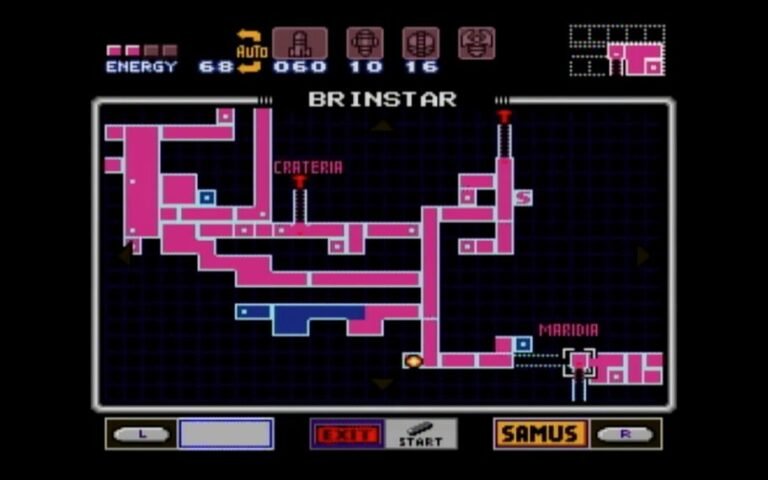
Just from this section of the map, you can see all the areas you’ve been to, where objects are discovered, where the map transitions to different kinds of areas, the name of the area and the surrounding sections, the overall shape of the map, and even where you are.
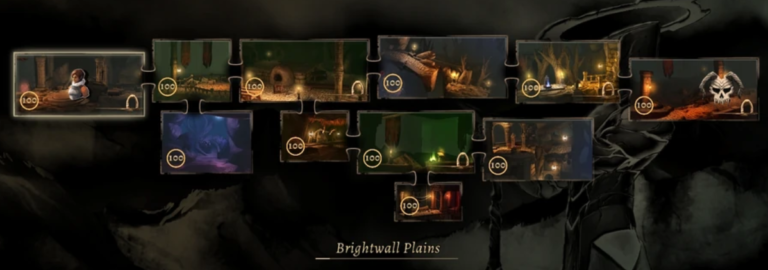
And here is the GrimValor map. Do you already see the issue? It isn’t a useless layout. You’re told where you are generally, where the boss is, what percentage of completion each area is, which ones have hubs, and which sections lead to which. But beyond that and some thumbnails of the environment, you aren’t told where things were discovered, what the terrain layout is, or your position in each section.
In fairness to GrimValor, its areas are more open than something like Super Metroid. They’re simpler overall. But they’re also complex enough to where you get lost trying to backtrack. Certain crossroads will tell you what areas are in which directions. The game even handholds you by telling you what happens to what when you activate a locked door or a lever. But those are more handholdy than intuitive. It would be far more rewarding for the player if the game didn’t blatantly tell you so much in the gameplay itself and instead let you learn via an actual drawn-out map.
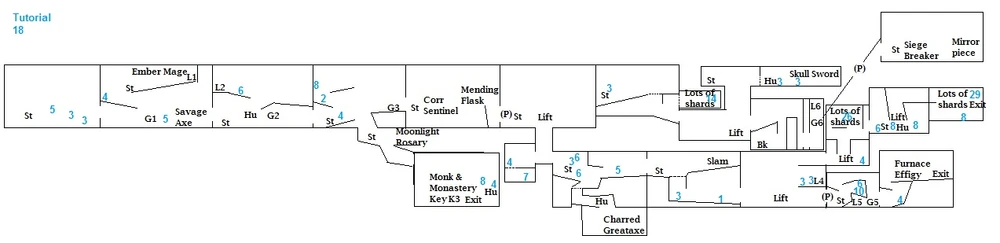
Credit to Drgrumble for sharing this: you can see here an illustration of the GrimValor map in just one area. In spite of the wall-jumping, double-jumping, air-dashing, teleporting, and destructible environments, the game is very horizontal. It’s overly simplistic and patronizing while being vague and aimless.
The obvious fix is to have it so when you go to your map, you can select each segment and have that open a more detailed map. It can show indicators of what areas you have and haven’t encountered, items you’ve seen but not picked up, and give opportunities for bits of lore. There could be an indicator for what kind of enemies you’ve encountered, and have that connect back to a codex for a greater lorebook. It’ll be covered far more in the third part of this, but this game is in desperate need of more lore.
But fixing the maps is honestly not particularly important, because the game isn’t challenging enough as it is in its layout.
Right and Left and Sometimes Other Directions
GrimValor has 5 areas, and it goes out of its way to make each unique in many aspects. The game gradually phases out one type as it introduces new ones. Some types of enemies are equivalent to others in programming, while others add or replace attributes.
Across the 4 main areas (as the fifth is just a hallway to get to its boss), I had an easy time recalling which enemies were associated with each segment. The first act has these tattered zombie-like enemies, the second brings in bulkier and more environmental foes, the third is mostly spiders, and the fourth has elite guards and mages.
Furthermore, each act has distinct architecture and colors. The first act is mostly outdoors in the ruins of Vallaris’ city, like one big cemetery.
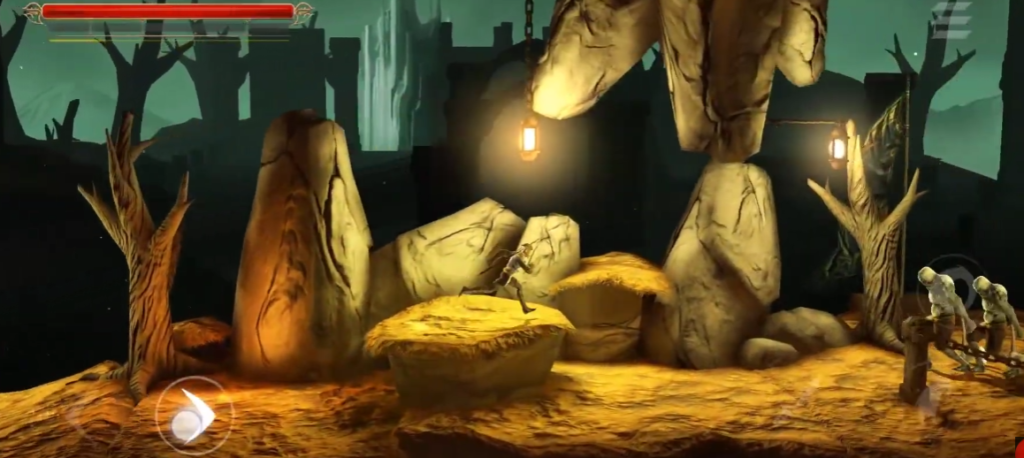
Act 2 is more like a fortress, though admittedly very similar to Act 1. Act 3 takes you underground, to these catacomb-like hallways covered in webs while adding an archive or library aspect.
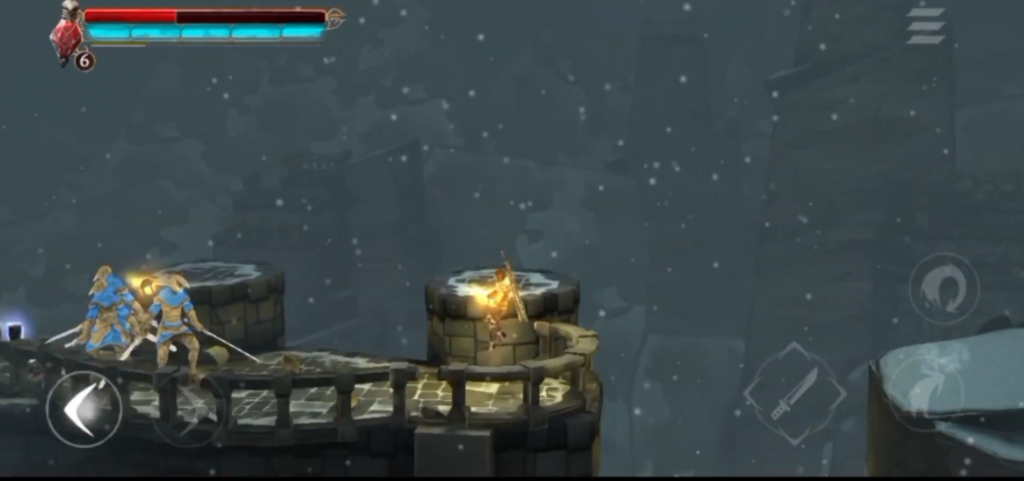
Act 4 is by far the most unique, being this snow-covered exterior with a secondary crystal cavern area. And Act 5 has this distorted space feeling to it, where entire hallways are shifted 90 degrees and the background is this void.
I personally got quite a bit out of the game’s presentation, but a consistent complaint I can’t ignore is that even with all that I’ve described, most of every act has very similar architecture and colors. There is a lot of orange and red in this game, with a lot of brick and stone.
And that’s not even accounting for the confusion that is the layout of this place. If I were to be generous, I’d say that game is just taking you in a straight line from the outskirts to the center of the kingdom. But the way the environments looks make it feel like you’ve gone from the outskirts to the castle to the underground of the castle to somehow a snowy biome outside the castle… and then into the void. This game is very horizontal–as shown by the maps–and could be helped a lot with far more vertical areas. Platforming is simple enough aside from certain puzzle sections. Let the player feel like they’re actually traveling across the kingdom you see at the start of the game. As is, everything feels like you’re stuck in some strange pocket dimension, with half-destroyed architecture just floating around without real indications of where you are.
Give the player an idea of progression with long platforming segments that take you on downward paths and upward climbs, not just to dead ends, but far more transition points than what exists as is. I’d settle for some staircases which make it more clear that you’re leaving the underground and heading into a new area.
It breaks my immersion when I try to figure out how the brimstone rubble of Act 1 could be in the same kingdom as the snow of Act 4. The mountain and city are mentioned, which gives the impression that the character is traveling some great distance. But that just doesn't match with the amount of land we've covered, especially with the mountains. And I’d be more than satisfied if the game just said magic was causing it to have random differences in temperature. But it doesn’t.
Some Fun Puzzles but Not Enough
GrimValor has some genuinely clever platforming puzzles. In Act 3, there’s an area you can’t reach unless you use your teleport ability on a larger spider enemy to get the height needed for access. And the game doesn’t hold your hand with this. It just spawns the enemy and shows you the area above your head. It lets you figure it out.
Likewise, the game has at least one cheeky hidden area in Act 4 that always stumps me when I replay, and I mostly mean that in a good way. It forced me to do some serious exploring and turn on my brain. But at the same time, the area that section is in has a pitfall you can’t climb back up. So, if you miss the spot, you have to go all the way to the next hub area and quick travel back to the area above that section, making for some less than enjoyable backtracking. The game has plenty of easy-to-moderate concealed pathways. And there are these insta-fail platforming hazards you can go through to unlock resources which serve as fun enough challenges.
With that said, I cannot tell you how often I got faked out in this game. I kept running up pointless gaps in ceilings, hopping onto empty ledges, and running through more detailed environments which had nothing of interest. The game could have inserted far more items and discoverables throughout. You could easily double the number of collectables with all the empty sections there are, and that’s whether or not they have enemies around. And these additional collectables don’t need to be gear or currency. They could be cosmetics or–more preferably–lore notes. If you come across clothing patterns or colors to change into, that would add more customization. And any kind of additional lore could have gameplay effects.
Imagine if every area had a certain number of incomplete notes about enemy types. And once you’ve gathered all the notes, you unlock a weakness toward that enemy. Alternatively, the developers could restructure the hunter mechanic to fit this.
Hunters are like mini-bosses. They’re scattered throughout the map as these beefed-up versions of specific enemy types. There’s no in-story reason for why they exist really. But imagine if, after you gather enough notes, they’d either summon a hunter to test what you’ve learned, or unlock a section of the map for you where the hunter is waiting.
Non-Platforming Puzzles
This game has maybe 2 puzzles which involve brain power, and one of them really doesn’t count as far as I see it. Near the end of the game, you come across some dungeon cells. One of them has an NPC locked inside of it. One has a lock on it in addition to the bars, and inside of it is a chest with goodies. The solution is to simply pull a lever to free the NPC, get the key from the NPC, unlock the other cell, then pull the lever for that cell to get the chest.
Then there’s the slime.
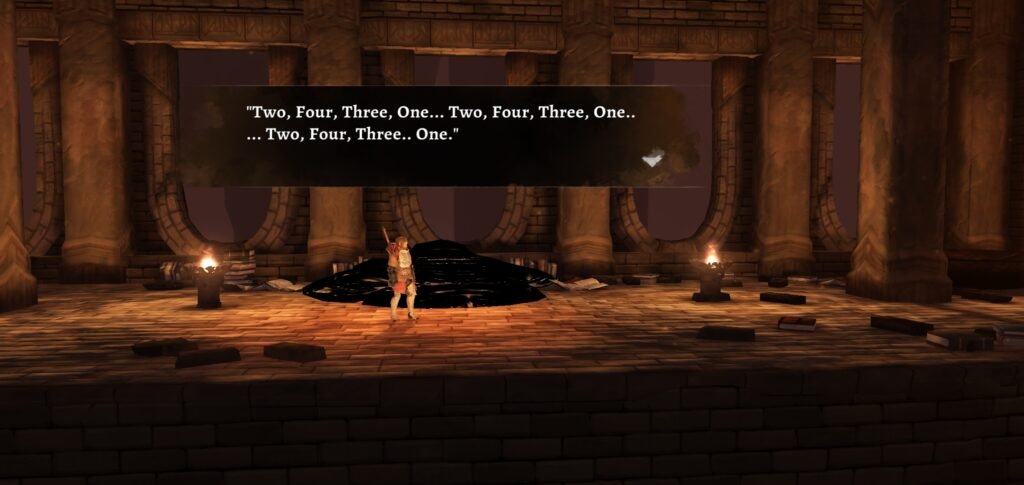
This black pile of Epic Mickey goo is just… here in a random part of the game. It’s described as a friendly slime, and it gives you the code to a braiser puzzle elsewhere. Both of these “puzzles” are frankly beyond lazy. The dungeon one is completely unnecessary. Nothing would have changed if the locked cells were open and the NPC was just there. It just wastes time.
The slime is so out of place. There are no other slime enemies. There’s one enemy which is close to this half-body goo creature, but they’re just basic fodder that never speak. And the puzzle the slime helps with isn’t hard to figure out without the code. I suppose if you really stretched it, you could call hunting for keys to locked doors a puzzle, but those are just fetch quests. Either the remake should get rid of the two semi-puzzles it has, or it should add more depth and frequency for them.
The slime puzzle, for instance, could be more of an interaction. The slime could quiz you on what you’ve encountered in the game thus far. Any time you answer incorrectly, it goes to one of multiple spawning locations. And once you answer enough of them correctly, it gives you the code you need for the braisers. And to discourage players from trying to force through the braiser puzzle, have it spawn enemies when you mess up the code.
The game could also utilize the many elevator platforms in some way. Maybe activating them in a certain order causes a collectable to appear. Or you could go even further by getting an enemy to step onto one, and send them somewhere where they’ll interact with the environment. Suffice to say, there are plenty of areas where the game could add more personality, and I noticed that most with Act 3. Speaking of which…
Prelude to the Lore Rant
Act 3 has a specific section where you have to climb this library tower. That area, and one in Act 4, are exactly what I wanted to see more of in the game with vertical movement. But at the top of the library area, all I came across were some collectibles.
… This is a library. Allow me to elaborate.
Throughout the game are these lecterns with bits of lore about Vallaris’ fall. There’s even a hidden one about Princess Alyssia. But that’s it. Why not have more spots where you can simply interact with a row of books or notable objects? All I’m asking for is a little bit of text on screen that says, “The title is [X] and it talks about [small bit of information].”
Areas like these would be wonderful opportunities to increase the number of NPCs. Aside from the random slime, there’s one other static NPC you can interact with in a specific place. But why not give the player a librarian who hasn’t yet been fully corrupted? Why not show a groundskeeper in Act 1? Or how about some poor soul stuck on the snowy cliffs?
What’s Next?
In the third and final entry, I’ll be covering the story of GrimValor. The lore of this game threatens you with depth, but most of it has to be inferred rather than confirmed. Believe me, I’ll have a lot to say for that.