Let’s be honest, when writing about anthropomorphized animals, you’re fighting an uphill battle of uncomfortable questions.
- What animals do you pick to give human-level intelligence?
- If you give them all human-level intelligence, does that include insects?
- How do you address the harvesting of meat, eggs, milk, leather, fur, ivory, and far more?
- If the animals are people, do you create new species to act as pets and livestock, or do you have anthro and non-anthro versions of each animal?
All of that to say… don’t ask characters in Zootopia where they get their hamburgers. You could ask the same for Sonic the Hedgehog’s chili-dogs, but funnily enough, the original Archie Sonic the Hedgehog comic book series subverted this problem by having all the humanoid animals be mutants, with non-humanoid animals strictly separated.
But who are we kidding? Even with that explanation, it’s always going to feel uncomfortable if you see a sheep eating lambchops, no matter how human they look. And that’s all without even starting to get into the ethical debates about just us humans harvesting animals (Madison Park had a notable song about that subject).
I’m not here to discuss real-world ethics. What I’d like to do is engage with a story experiment, and I have a short indie game called Carnivore! to thank for that.
A Nice Dose of Trauma
Without spoiling too much of the game, Carnivore! has you play as a little sheep lady with a terrible life. Much of the game is set in a restaurant. Just about everyone is some kind of animal, and the staff of the restaurant are slowly being killed to serve the customers. And it’s only a matter of time until our little lamb protagonist will be on the chopping block.
The main antagonist of the restaurant portion is the owner/chef: the Pig. And through certain interactions, the game addresses the issue of running out of staff when you’re serving them to a hungry wolf couple: that being that the Pig is a survivor.
The Pig is willing to throw whoever he needs to under the bus so he can keep going. And the game has some neat environmental storytelling to hint that the Pig has replaced his staff many times: tricking people into his employ only to use them to keep himself off the menu.
During a confrontation with the Pig, some very interesting dialogue is had. Again, I’d rather not spoil it all, but the two lines which especially stood out to me were…
“You were born in the wrong world.” (Spoken by the Pig)
“With enough gumption and spit, I would soon be promoted to WOLF.” (Spoken by a separate character)
Both of those lines gave me the impression that there could be some kind of reincarnation/transformation element to the game. It’s never confirmed, but it stuck with me: What if the animal people could change species in a promotion system?
And thus the cogs started turning.
Eat Your Neighbor: Project Echelon
This concept is set in a world called Census. Think of a 1920s – 40s Noir city which goes for as far as you can see. Beyond the city itself is a vast wilderness, but the world itself is seemingly quite small: only being the size of a state, like say… California.
The inhabitants of Census are called Sapiens. All Sapiens are humanoid beings which traits based on specific animals.
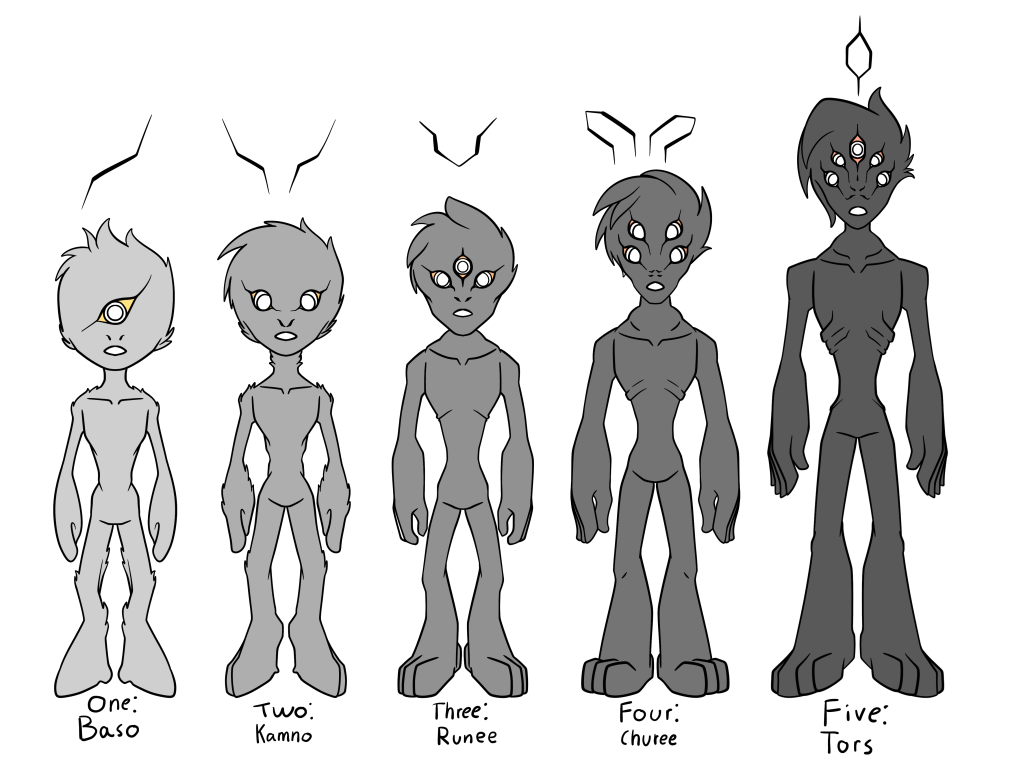
The designs here are only basic versions of what Sapiens look like without specific animal traits. In future posts, I’ll include rank and sub-rank illustrations to show what they all look like (sheep, wolves, skunks, foxes, etc.)
There are 5 ranks of Sapiens (Baso, Kamno, Runee, Churee, and Tors), each with variations depending on the animal type belonging to those ranks. You may notice a particular feature in the number of eyes each rank has. The number of toes, fingers, and structure of the body are also specific to each rank.
The Hierarchy
When born, there are 2 types of Sapiens: Legacies and Basics.
Legacies are traditionally born children to 2 Sapien parents. They can be born into any rank, but they are typically born either at the same rank–or 1 rank below–the parent with the higher rank. As such, any Legacy Sapien can be born from any combination of Sapien types. However, there are never hybrids. Legacies will always take on the traits of a single type from each rank.
Basics manifest from the very ground itself as young adults. They appear in the wild, grassy fields surrounding the city, called The Incarnate. Unlike Legacies, Basics are always born at Rank 1 (Baso). Many speculate in-story that Basics are reincarnated after death–some even claiming they are the souls of those harvested–but no actual evidence shows this to be true. Basics have no memories.
Rank determines one’s base-level intelligence, strength, diet, lifespan, and of course appearance. Some lower rank sub-groups are larger than higher ranks, and thus stronger, but will lack the same amount of aggression (a cow is larger than a wolf for instance). Having 1 eye limits depth perception. Depending on where you are in the ranks may make it harder or impossible to eat/get sustenance from certain foods.
Grunt Prey: Rank 1 (Baso)
- Strictly plant-eaters. Made up of sheep, cows, llamas, goats, and rabbits.
- Lowest intelligence. Single eye (impaired depth perception). Simple anatomy.
- Main occupation: physical labor or servants.
- Harvest Status: Moderate, typically secondary resources (leather, fabric, milk) rather than meat.
- Most are not harvested until reaching a certain age as part of the Civility Incentive (more on that later).
Harvest Prey: Rank 2 (Kamno)
- Plant-and-Insect-eaters. Made up of chickens, crabs, deer, ducks, bass, finches, and geese.
- Moderate intelligence. Two eyes. Semi-sturdy anatomy.
- Main occupation: Harvest resource.
- Harvest Status: High, frequently for meat as well as secondary resources (milk, eggs, leather).
- Kamno are given healthy, but not educated, upbringings to ensure good meat when harvested.
- High population numbers in order to give themselves–or loved ones–more time to be promoted to next rank for safety.
- High flight-risk.
The Citizen: Rank 3 (Runee)
- Omnivores. Made up of badgers, pigs, bats, bearded dragons, foxes, raccoons, and skunks.
- Standard intelligence. Three eyes. Sturdy anatomy.
- Main occupation: Intelligence workers, law enforcement, and community organizing.
- Harvest Status: Low. Meat is high-sustainability but low quantity. Some secondary resources harvested (fur, scales)
- Pigs specifically have high harvest potential, but often avoid this through societal influence and political power.
The Predator: Rank 4 (Churee)
- Carnivores. Made up of monkeys, basset hounds, bobcats, coyotes, eels, hawks, and rattlesnakes.
- Monkeys are unique as the only omnivore Churee type.
- Standard intelligence. Heightened stamina and aggression. Four eyes. Enhanced anatomy.
- Main occupation: Business owners, law enforcement, community leaders.
- Most Churee are oppressive, especially without Tors to reel them in.
- Harvest Status: Illegal. Meat is high-sustainability but difficult to harvest. Secondary resource harvesting is banned except for select circumstances.
The Apex: Rank 5 (Tors)
- Carnivores. Made up of alligators, anacondas, wolves, eagles, and tigers.
- Highest intelligence. Highest stamina and aggression. Five eyes. Highest anatomy.
- Main occupation: Various. Most Tors are treated like royalty and partake in whatever industry or entertainment they wish.
- Most Tors live outside of the city, and are treated religiously. They are rumored to go on spiritual journeys: making dangerous treks into the unknown to relay to the people.
- While some Tors are oppressive–like the Churee–most demonstrate maturity and moderation when present.
- Harvest Status: Highly illegal. Consuming meat is known to cause side effects. Secondary resources (eggs, fur, skin, teeth, claws) are only harvested if donated.
Promotion
Being promoted, as well was what type within a rank a Sapien changes into, is based on diet and behavior. A Rank 1 who eats insects will quickly turn into a Rank 2. A Rank 2 who eats Sapien meat will turn into a Rank 3. Eating meat exclusively will turn a Rank 3 to Rank 4. And Rank 5 is the most rare: being entirely determined by personality.
The qualifiers for promotion aren’t always clear, and the transformation could happen at any moment. Some transform after eating insects or Sapien meat for the first time. Others can go years without change. Typically, you can guess what type you’ll end up as based on personality. Temperamental Rank 1’s are likely to become a goose or duck as Rank 2. Cunning Rank 2’s are likely to become foxes or raccoons. And so on.
Sapiens can’t just eat whatever they want, however. Especially for Ranks 1 and 2, eating outside of your type’s diet can cause illness or even death. Most will be safe to start by eating safely-labeled insects to steadily reach promotion, and the same applies for Sapien meat. If a Sapien wants to go from Rank 2 to 3, they should only eat Rank 1 meat to avoid health problems.
It’s also possible to resist the transformation. For Ranks 1 – 3, it’s fairly easy to pull back and refuse the urge to let your body transform. But it’s near-impossible to resist for Ranks 4 and 5. And as said before, when these promotions happen are unclear. They aren’t decided by committee. It’s an invisible force causing it.
Sustainability
Notice how each Rank had a sustainability indicator for their meat. That’s because consuming the meat of higher Ranks–and specific types within those Ranks–will invigorate those who can digest them better. Depending on the meat, you can go without starving for longer, with increased stamina, heightened senses, and supposedly increased intelligence.
The higher in a Rank you are, the less lower Rank food will sustain you. A Rank 5 will still get some sustenance from Rank 1 meat, but insects and plants can only add flavor to their meals. And while Ranks 3 – 5 will give far more sustainability, it’s frowned upon to harvest from these more protected Ranks. Once you get to Rank 3, almost all meat is strictly donation-based, at least in “civil” society.
Society in Echelon City
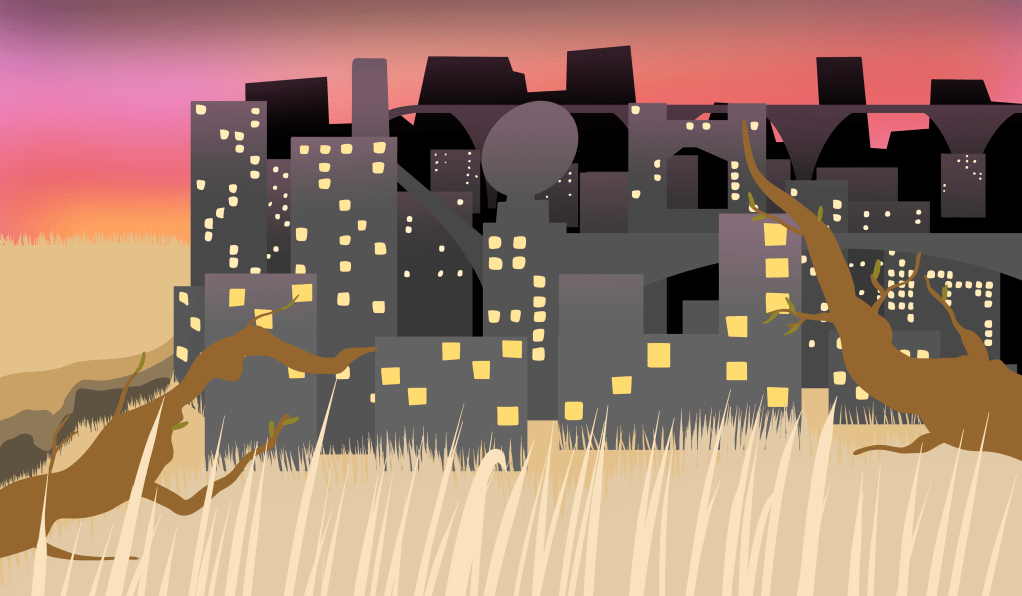
I’ll save more details on this for a later post, but as an introduction, this society operates where Ranks 1 and 2 are dominated by Ranks 3 – 5. Ranks 1 – 2 lack the same rights as higher Ranks due to their lifespan, intelligence, and resources.
Sapiens are incentivized to climb the Ranks to achieve not just societal protection, but also improve their physical/mental structure. Rank 1’s are encouraged to get promoted to Rank 2 for better harvesting potential. Rank 2’s are offered plenty of benefits to stay in their Rank to be harvested. As such, most Sapiens either stick to being Rank 1’s, or they work as fast as they can to get to Rank 3 for protection.
Many bleeding hearts from Ranks 4 and 5 have a tendency to adopt lower Ranks into their homes to protect them. Some will employ lower Ranks and make them indispensable to avoid the “harvest draft”. Some will go as far as to falsify documents and make it appear that their lower Rank adoptees are Legacies, and thus have blood protection.
None of these protections are concrete. If the population of a main harvest type (chickens, deer, pigs, sheep, cows) doesn’t meet the necessary quota, officers of the law will turn to those with protected labels.
What About the Civility Incentive?
Again, without detailing everything, the Civility Incentive was put in place to demonstrate “personhood decency” to all Ranks and types. The world of Census is one of necessity and opportunism disguised as necessity. The government claims not to take pleasure in the cruelty of its structure, and thus has a number of benefits and protections in place.
Ranks 1 – 3 have age-based protection from harvesting depending on their types. And law enforcement is meant to bring the hammer down hard on anyone who subverts those shields.
For example, if a cow-like Sapien’s shield ends after age 30, any citizen who tried to harvest the cow before that age would face repercussions depending on the severity. Depending on the population quota and seriousness of the crime, the offender could even be harvested in the victim’s place (even if the offender is a Rank 4). And victims can receive protection extensions.
Lower Ranks (mostly 1 and 2) are regularly interviewed by social services to check their intelligence and other capabilities. While uncommon, highly intelligent lower Ranks are still possible. And those who show promise can be given lifetime protections. Most are offered “promotion fast-tracks”. Scholarships and internships.
This is All Lawful, Right? Right?
There’s plenty of underhanded behavior throughout, both from Predator and Prey Ranks. Everyone’s trying to get by, and most are hoping for solutions to come down from above to change things. But as things are, it’s a pretty cutthroat society.
What’s Next?
I’d love to work on this side project more. I have ideas for drawing up profiles for the different Ranks and types. I have ideas for how Census’ history is structured. I even have the start of an idea for a narrative. BUT… I need to know there’s an audience for something like this before I put in that work. Most of my free time is spent on the next Christelan novel (Ritual) so time taken away for something like this needs some juice.
If this project interested you, please check out my other posts. I have an older series for a video game concept and a fantasy series concept I wrote for a writing jam.
Please give some love to Siebee, and the creator of Carnivore!, CatTrigger.
 Tris' Thoughts
Leave a comment