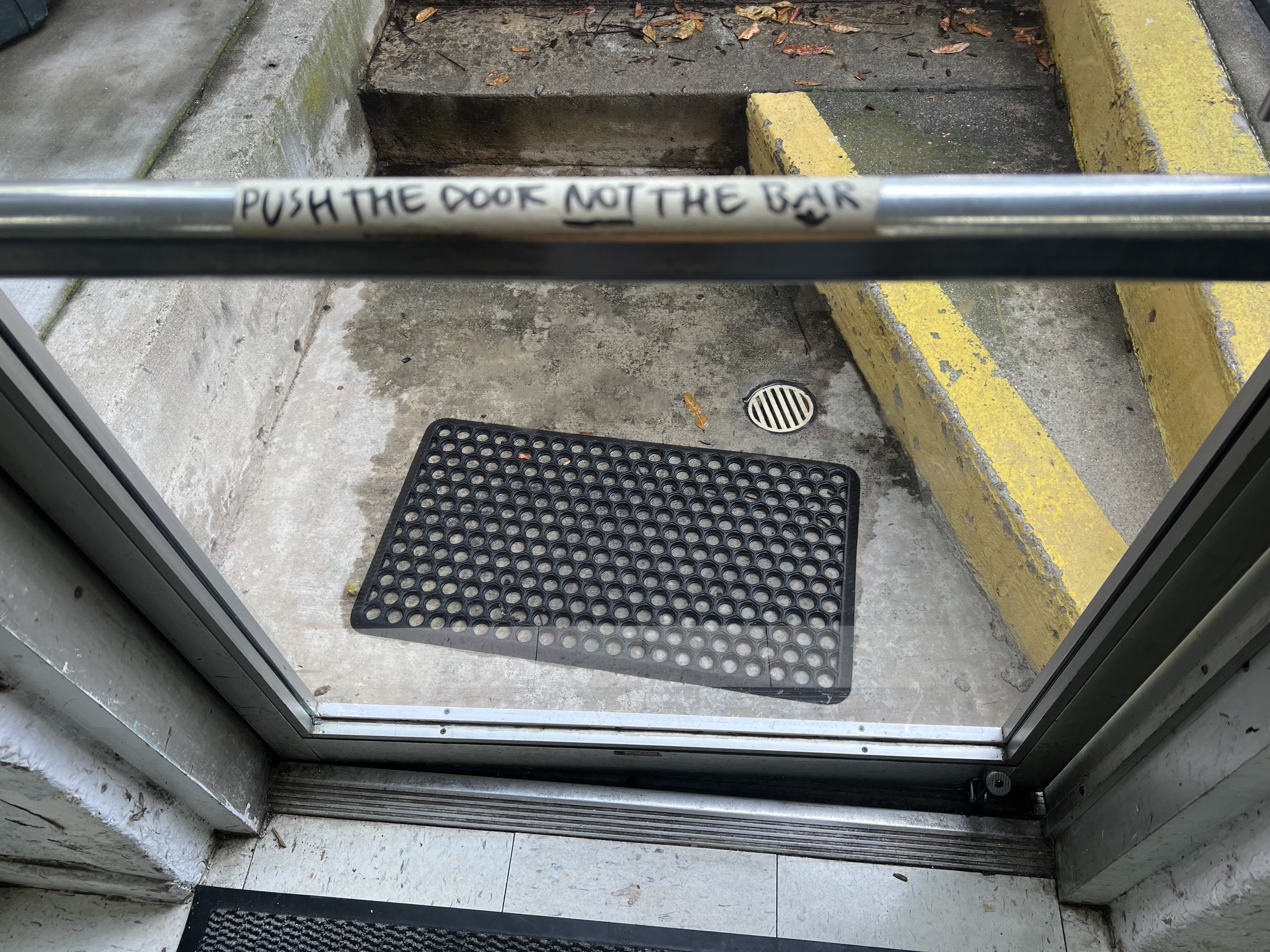
*BAM* was followed by *CLAMP* which was followed by *tk tk tk*
Missus Claire, Missus Broth, and Martin Prer shared a veteran ache as they glanced at each other. Someone was trying to enter the community hall from the rear, push bar door. But since before young Martin was born–and possibly even the two, elder ladies–that door locked automatically upon closing.
It was unfortunate just how convenient the door was. The playground was just across from it, and the asphalt game square just outside the facility had a straight line to it. In contrast, the main door–larger, more welcoming, and seldom locked–was the same distance away, but required an ever-so-slightly wider turn to reach.
The three must have theorized what made this door so preferred dozens of times without realizing some of those discussions had the same exact start and finish. And now, just like any other occasion, they briefly locked eyes to gauge who might go and open the door. Half of the time, whoever was trying to get in had already given up and gone to the front entrance.
Young Martin Prer was the volunteer this time. The youth was only a class assistant to the leaders then, and such a position came with a self-imposed obligation to make things easier for the more experienced ladies. He wouldn’t have gone to the door if Missus Broth hadn’t gotten up from her documenting table. “No no, allow me,” was the silent implication.
Martin made it in time to let in another original member of the institution: Missus Garrie. She didn’t think Martin verbally, nor was it necessary. They were all used to the routine. Instead, Missus Garrie shared something Martin thought would make his life easier, when in fact, it only served as a sad life lesson.
“You know, if you push in that button at the top, the door will stay unlocked.”
It took Martin a moment to locate the button despite Missus Garrie pointing directly at it, but sure enough, there was this little rectangle in the top right corner, symbolically surrounded by cobwebs. Martin pushed it in, sounding a hearty *CHIK* and the door relaxed with a slight *clank* into the frame.
The door had a stopper at the bottom. Martin had seen it used and used it himself. But aside from it an unwanted source of cold air in the cold seasons, some petty indignance made him not want to use it, especially now that he knew the door could safely close without locking automatically.
Martin didn’t expect the annoyance with the door to stop overnight. So any time he saw someone passing through it–or asking to be let in–he passed on Missus Garrie’s wisdom. It was far too mundane of a time saver to want recognition for while, at the same time, far too helpful to not spread around.
Two years went by. Martin was now one of the program leaders, though still a young adult. He hadn’t kept track of how often he still had to let people through the back door. He didn’t think about it much outside of when the passive inconvenience announced itself with more *BAMS* and *tks*. But then he saw some duck tape on the door’s bar with a black marker message written across it:
“DON’T TOUCH THE BAR”
Martin didn’t understand the message at first. He assumed the door was broken. But the tape never went away. He didn’t ask anyone to clarify it either. It didn’t inconvenience him enough to bother. But by chance, he experimented, and felt very stupid after realizing the bar is what undid the button in the top right corner. When the bar was pushed, the lock mechanism reactivated, and the door would become a mild problem again.
Martin committed this new information to memory immediately, adding it to his ammunition when informing the facility staff, visitors, and members. But the problem kept happening. And Martin became more conscious of its frequency.
Another year passed. The original sign had worn off, so Martin took it upon himself to write a new one. Since he first saw the prototype warning, he thought it was a bit vague. His replacement would be far more helpful.
“PUSH THE FRAME, DON’T TOUCH THE BAR”
Martin continued to inform people verbally. Eventually, he even spoke to a few of the facility board members, asking if a more formal sign could be put up. He was met with neither confirmation nor condemnation. They thought the idea was reasonable enough, but nothing was done.
Then, months after the first replacement, Martin found his replacement tape half-torn off. All that remained legible was “TOUCH THE BAR”. Everything in his experience at the facility told him this was a coincidence, but a prick in the back of his head wondered if this was malicious.
It wasn’t of course, or so he insisted. He was just being sensitive. But how was it that the original message lasted a whole year while his replacement only a few months? Bad luck most likely.
Martin wouldn’t be so easily deterred. So he peeled off the tape and made a final version.
“PUSH THE DOOR NOT THE BAR”
Perhaps writing “frame” was too confusing for people. After all, half the people who came through that door were minors, and half of those minors were below High School level. So “door” and an underlining of “NOT“ was an easier message to digest.
Year after year, Martin watched people he had informed time after time ignore this easy correction. When leaving, they’d push the bar. When coming to enter, they’d barely acknowledge Martin’s gesture to the rectangle in the top right corner. When he pointed out the tape message, people acted as though it were invisible before.
Worse of all, Martin caught Missus Garrie herself pushing the bar on her way out. Once every so often was understandable, especially while busy or in a hurry. But why would someone who knew the facility in and out contribute to the inconvenience?
Martin felt a pang of guilt, but he decided to perform a cynical experiment. When he saw Missus Garrie come through again, he told her about the rectangle button. Her response brought a sad clarity.
“Oh, really? I didn’t know about that. Interesting.”
Missus Garrie wasn’t senile. She wasn’t particularly forgetful. And Martin never asked for clarity. He couldn’t think of a way to explain how she passed the information to him some eight years ago now that wouldn’t sound dramatic or condescending.
The clarity was simple: People didn’t care enough. It was easy to fix and easy to get into the habit of practicing. But people couldn’t be bothered. Martin quickly found himself sinking into the shoes of other peoples’ feet. All the times he was reprimanded as a child for ignoring mundane–but useful–habits came flooding back to him.
“Rinse your dishes and put them in the washing machine.”
“Put the toilet seat down.”
“Turn off the light when you leave the room.”
“Brush your teeth before you go to bed.”
It took him most of his childhood to get most of those down and more. And even into his adulthood, he slipped out of certain routines. And it wasn’t any surprise really that his parents eventually stopped reminding him. How tired they must have been, trying so many different methods. How many paper signs did they tape to walls? How many reprimands did they warn about?
Martin still wondered if Missus Garrie actually forgot about the bar door trick, or if she simply accepted that nothing would change. Forgetfulness or apathy, Martin realized all his years trying to make things just a bit easier were a waste of breath. Because the problem wasn’t big enough to care about.
It was just small enough to be annoying.
 Tris' Thoughts
Leave a comment