Beyond Continuity Intro
Beyond Continuity is a series where I take a story or character and give my take on how I would present them. The goal is to take what exists in official continuities and improve on it or to show alternate paths the story or characters could have taken. Any and all suggestions on improvements to these entries are welcome.
The Appeal
Minecraft is an insanely, overwhelmingly massive landmark in gaming and internet culture. It is the best-selling game of all time with over 350 million copies sold at the time of this post. It remains relevant after over ten years, with a popularity that has created an entire sub-genre of Youtube content. And its secret can be found in its very introduction.
“Let’s go to a place where everything is made of blocks; where the only limit is your imagination. Let’s go wherever you wanna go: climb the tallest mountains, venture down to the darkest caves, build anything you want, day or night, rain or shine. Cause this is the most significant sandbox you’ll ever set foot in.”
“Build a majestic castle. Invent a new machine. Or take a ride on a roller coaster. Play with friends. Build your own little community. Protect yourself with the strongest armor that you can craft. And fight off the dangers of the night.”
“No one can tell you what you can or cannot do. With no rules to follow, this adventure, is up to you.”
In this post, I will detail what I believe is the core appeal of Minecraft and how it has been utilized well by the community. I will also contrast that with how I believe it was wasted with the 2025 film. Then, in Part Two, I will give my own interpretation of the game’s lore as I believe would be appropriate.
Minecraft’s core is creative expression. And while its many updates inevitably led to mixed opinions, the player has never been limited in how they want to approach the game. You can load up an old version that has aspects you miss or lacks ones you didn’t care for. You can install independent mods promoted or left alone by the developers. You can join servers for professionally programmed minigames or civilization simulations. And that’s all without talking about the in-game mechanics themselves.
Minecraft sets you in a world you can play without enemies, against hostile creatures, or with control over the entire world. You can destroy and rebuild everything: from trees to rare minerals, complex mobs and simple pets. With redstone, you can create complex machinery.
And then comes the lore. Minecraft’s worldbuilding is minimal. Most of the game gives you tiny pieces so that you, the player, can decide what the story is. Enchanting tables show a foreign language with no cipher. Boss enemies require detailed steps to construct without background to explain their origins. And remnants of crumbled societies can be found everywhere, with scattered resources and scant occupants who don’t speak your tongue. You are a foreigner, dropped into a mysterious and daunting world, and left to decide how you live your virtual life.
The Creatives
I will never forget this beautifully haunting–if dated–animation by Slamacow made only 5 months after the official release. This 4-minute story shows the protagonist–Steve–and his pig companion retreating to their fortress home only to be pursued by the enemies of the game. The video always gave me this claustrophobic feeling, as if the protagonist had trapped himself unintentionally by building and expanding to the point where his world was darkened.
The video showcases Minecraft’s boogieman–Herobrine–an urban legend copy of Steve’s appearance with glowing white eyes. Herobrine’s origins remain an almost total mystery as he has never been officially integrated into the game (save for joke debug messages). Herobrine acts as this supernatural threat which Steve and his companion must slay to survive. The music’s lyrics speak to the struggle and persistence of the protagonist: “I’ll keep going, just stay by my side”. It has this level of desperation, implying that if Steve’s one companion–his pig–were to dissert him, get lost, or die, Steve would lose his resolve.
This is only one of hundreds of creatives throughout Minecraft’s lifespan who took the game’s setting and created a scenario worthy of an official series or film. I could spend forever listing them but for the sake of efficiency, I’ll stick to five.
- Fallen Kingdom by CaptainSparklez was the first of a series following a minecraft monarch who loses his empire to the hostile mobs. Some may notice the song being a parody of Coldplay’s “Viva la Vida” and treat the video as some silly cartoon to not be taken seriously. But beyond having the skin of a vibrant and friendly-looking sandbox game, the story is a compelling epic about the loss of a civilization, the recovery of its protagonists, and the fight for the world against various evils.
- An Egg’s Guide to Minecraft by Element Animation is a more relaxed and comedic hero’s journey with Isekai elements. A British Egg–Jason–ends up in the Minecraft world and meets the game’s protagonist, Steve. The two go on a journey to mutually learn more about the world and what Steve’s purpose in it is. Sadly, the series never finished in part due to the death of Steve’s voice actor, Scott Stoked.
- The Dream SMP is a collaborative Minecraft server where over 20 different participants play out an ad-lib storyline centering around conflicting civilizations. The appeal of the series was in how much of it was either unscripted or loosely organized. You could watch the storyline from so many different perspectives and get many different interpretations of who was in the right or wrong. While I strongly believe the series unraveled the closer it got to its conclusion, it can’t be ignored just how popular the series was. And were it not for the Dream SMP, many other story-based SMPs (Survival Multiplayer) wouldn’t have been created.
- Hermitcraft is one of the longest-running Minecraft SMPs, having just concluded its tenth season at the time of this post. It hosts somewhere orbiting 25 members in a regularly-refreshed server focused on using each person’s unique creative expression to push Minecraft to its limits. If I had to pick the perfect series to adapt into a film or animated series, this would be the one. Hermitcraft takes what’s in the game and has its members create bases, civilizations, games, stories, and much more with it. This family-friendly series has personalized episodes from every member, allowing for a plethora of personal adventures tailored to their own interests and those which overlap with each other.
- The LIFE SMP by Grian is a survival, battle royale series where a group of players (or Lifers) play through group sessions in a bid to be the last man standing. All Lifers start with a specific number of lives, with what life you’re being determining what kinds of hostility you can demonstrate. Every season uses a new gimmick, such as deaths resulting in lost time on a life clock, being instructed to perform secret tasks, or having your health tethered to another player. But the true magic of the Life SMP is in its relationship dynamics. Lifers will form and break alliances based on their instinctive traits, choice of character direction, survival opportunities, betrayals, and more. With eight episodes per season, this efficient and thrilling series has lasted seven seasons so far.
Beyond these examples, you’d be hard-pressed to miss the diverse interpretations of Minecraft lore. Some try to be as strictly accurate to the game, using blocky designs and all game mechanics. Others branch out into a more real-world design or something in the style of anime or action cartoons, yet still maintaining the core aspects. Regardless of which is used, these ideas are made with an understanding of what makes Minecraft so engaging: the interpretative potential.
And… that’s what makes the “A Minecraft Movie” film so disappointing.
The Jack Black Product
The 2025 Minecraft Movie let many people down for many valid reasons. But to me, the most poignant is comes from the film’s lack of interest in its source material. While Minecraft encourages players to blaze their own trails, it still has a main campaign of sorts for those who want to “complete” the “main story”. You start with next to nothing and build basic wooden tools. You upgrade those tools and unlock different materials as you do. Once you have a diamond pickaxe (or are skilled with a bucket) you can gather Obsidian to make a Nether Portal.
This stage of the game usually takes the largest stretch of time as you go from wood to stone to iron to diamond equipment. And during that journey, you become acquainted with many of the Overworld’s (the main setting) biomes, enemy mobs, and friendly mobs. And then you go through the Nether Portal and arrive in a Hellscape (the Nether).
The Nether holds the final equipment upgrade in the form of Ancient Debris to make Netherite, but for the main quest, players must locate a Nether Fortress and acquire Blaze Rods. Combining this with Ender Pearls from Endermen gives you an Eye of Ender. When thrown, the Eye of Ender will lead the player to a Stronghold, an underground structure long abandoned and decayed. And within this stronghold is an End Portal. The portal can only be activated by having a sufficient number of Eyes of Ender to fill its slots. And once activated, an ominous sounds echoes through the fortress…
…because you’re about to fight the boss.
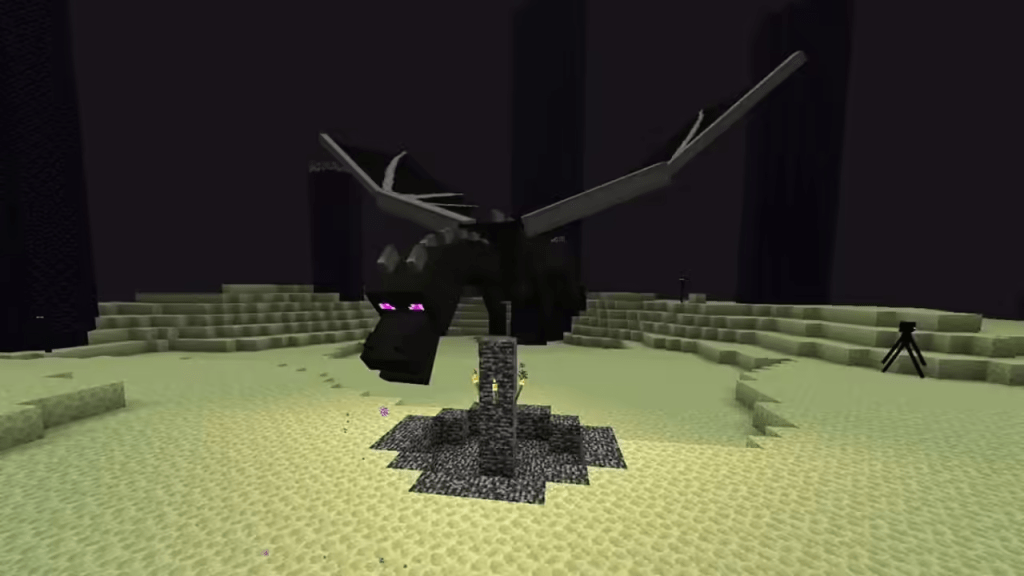
You travel into this alien landscape of floating white islands in a black, starry void. And there stands these pillars of Obsidian with floating crystals atop them. The End is filled with Endermen but the true threat is the giant, black Ender Dragon. You must take out every End Crystal and then slay the dragon, awarding you experience flecks and a dormant Ender Dragon Egg. Then, you return home.
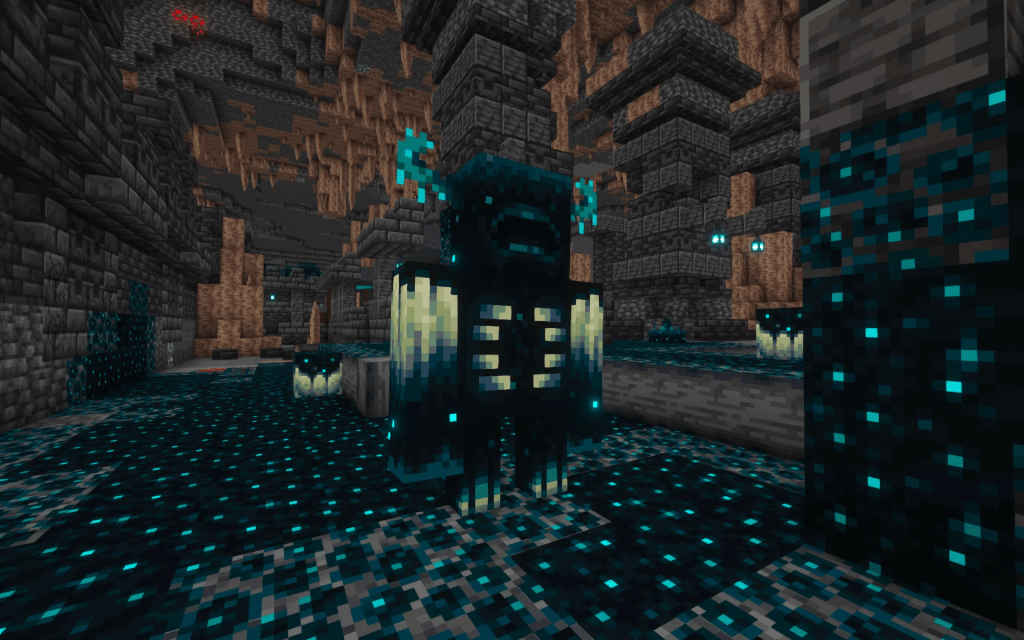
Even after completing the game’s main quest, there are additional quests you can pursue. Most recent at the time of this post is the Warden. By traveling deep underground in the Overworld, you can encounter this haunting, spreading bio-mass called Skulk. And if you travel far enough, you’ll encounter an Ancient City: one of the many ruins of the game with scant lore. Spawning from the Deep Dark is the Warden: a sound-detecting boss that hunts you. And by slaying it, you gain a mysterious Skulk Catalyst Block.

Before the Warden, there was The Wither. In the Nether Fortress are these taller, black variants of the Overworld’s skeleton enemies. When they strike you, a life-draining effect eats away at your health temporarily. But if you slay them, there’s a chance they’ll drop one of their heads. Should you take 3 Wither Skeleton heads and place them on a specifically-shaped formation of Soul Sand, you will summon the deadliest of the three bosses. The Wither is able to destroy any block type except Bedrock and will fly around the world, obliterating everything and everyone. But should you kill it, you’ll be awarded a Nether Star. This can then be used to craft a Beacon: a device capable of giving an area-of-effect boost to players.
All of that comes from just a fraction of the content in the game. So many questions are prompted by the Main Quest alone, introducing three different dimensions, entire species, interconnected, arcane recipes, and remnants of civilizations long lost. You could fill an entire Minecraft film with just the journey between the protagonist first arriving and traveling to the Nether.
Or you could approach the story from the Multiplayer perspective, which the official movie did in aspects. Minecraft: Story Mode followed a group of protagonists in a setting where people have already populated the world and most know about much of the universe’s lore. But even with the protagonists being familiar with the lore, there was still room to explore the setting, show how the characters expressed themselves creatively, and integrate their own interpretations of the game’s content (the Wither, The End, Command Blocks, and Endermen being especially prominent).
A Minecraft Movie is bogged down and overstuffed. It makes the mistake of having the protagonists travel from the real world into the Minecraft world. Because of this, the plot had to spend time introducing all the real-world context for each protagonist and tether them to it when they enter into the Minecraft world. The characters spend so much of the film being surprised at all the Minecraft mechanics, leading to the film acting more like a tour ride through the gimmicks rather than an actual story.
And you know what? An Isekai-styled Minecraft movie can be done well. But this was not the way to handle it. With so many protagonists and so much set-up before delving into the Minecraft world (not to mention the Villager subplot), more and more time is lost on actually getting the audience invested in the Minecraft Overworld.
The movie is overly comedic, always taking an opportunity to poke fun at the game’s content and making exploring the mechanics secondary at best. Instead of getting into why Endermen drop Ender Pearls, or how Villager civilizations cropped up, Jack Black will start singing about lava-baked chicken. Jack jumps around the movie, naming key items in a silly way and giving a basic rundown on how to use it.
The movie acts embarrassed to be in its setting, forcing everything to look and seem ridiculous. That’s demonstrated most by the art direction. Instead of going fully realistic and reimagining the creatures beyond their blocky forms—or going fully loyal by making things pixelated cartoons–the art style is uncanny: like real creatures and people were pushed into a square molder. And the characters treat these as such. The animals are ugly. The villagers are unsettling. And the block materials aren’t even consistent in size.
But even further, the movie breaks itself with the meta humor. Jason Momoa’s character points to a pink sheep early in the film and insists that the sheep is some kind of quest-giver. Jason’s character is a gamer but in the context of the film, the Minecraft world isn’t something like Jumanji where you’re transported into a game. It’s treated as a different planet or dimension. Lines like calling a sheep a quest-giver are generated from the headspace of “This is a game” and not “This is a real place”.
And as I hinted with the Minecraft tour comment, so much of the game’s most iconic aspects are glossed over in favor of what the film decides should be the main threat: The Piglins. these are denizens of the Nether: armored pigmen who horde gold and will turn into Zombie Pigmen upon traveling to the Overworld. In the movie, the Pigmen are a grand army, seeking to take over the Overworld and destroy creativity. Instead of the Ender Dragon, Warden, or Wither, the movie creates its own, original bosses in the form of “General Chungus”, “Malgosha”, and “The Great Hog”. None of these characters are actually in the game. And that isn’t bad by default. But these are original creations being used to supplant existing, popular antagonists. All the originals–Creepers, Zombies, Skeletons, Spiders–are rushed through and skipped over to get to the Piglins.
At the end of the day, A Minecraft Movie doesn’t break the mission statement of Minecraft–“No one can tell you what you can or cannot do. With no rules to follow, this adventure, is up to you,”–but the way it executes its ideas is drastically uninspired. The content of the game is not taken advantage of. Most of the crafting happens off-screen, with almost no structure-building, and exploring is replaced with traveling across pre-mapped landscapes with almost nothing being dissected.
Minecraft: Story Mode introduces an original idea with the Wither Storm early in the game. By using a command block, an early antagonist creates a super-charged Wither. Like The Great Hog or Malgosha, the Wither Storm isn’t from the game. But the difference is that Story Mode spends a lot of its time showing characters building structures, showing off unique and contrasting civilizations, and having characters talk about in-world mechanics in detail (how to build tools, discussing different potion types and their ingredients, discussing in-universe history, etc.). And the Wither Storm is created by using in-game mechanics in an artistic way. The Command Block exists in Minecraft.
Meanwhile, the movie takes inspiration from Minecraft Dungeons, a spinoff game, with an object called The Orb of Dominance to power-up its villains. This item is not in the main game, nor are there any links to the real world from it.
But… with that said, this isn’t just about my disappointment with the movie. I could go on for a very long time about that but what this post is about appreciating how Minecraft can be–and has been–explored using its in-game content and one’s imagination. And in Part Two, I’ll give my own interpretation of the game’s lore. By no means should it be seen as how Minecraft “should” be interpreted, but I will strive to make my version of the lore rely only on what exists in the game with some exceptions for long-running community content (specifically Herobrine).
 Tris' Thoughts
Leave a comment