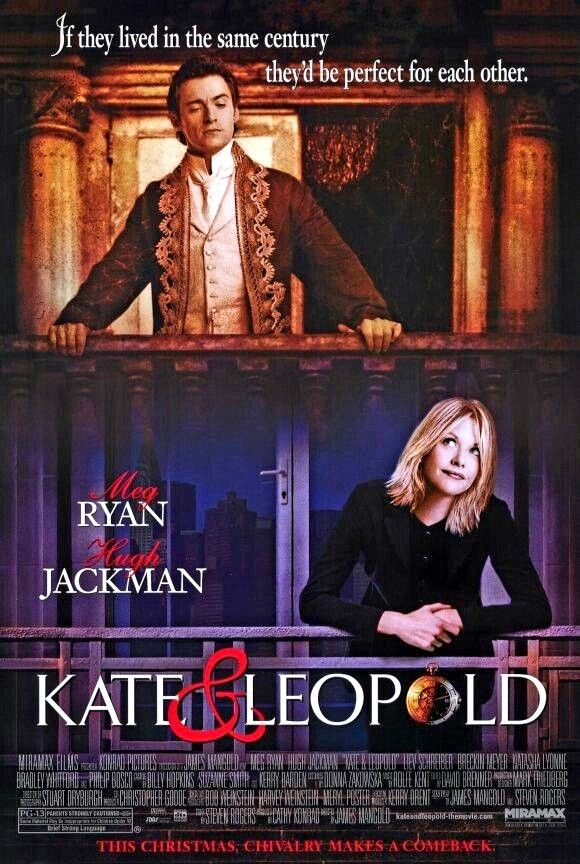
I could talk for hours about 2001’s Kate & Leopold. It has a well-integrated soundtrack (with the iconic “Until” by Sting as the film’s signature piece). The pacing carries momentum, with well-balanced perspective scenes for its many, distinct characters. And it uses a personal favorite style of mine in how it approaches supernatural elements.
I’ve talked about this when discussing another film–Stranger than Fiction–but I quite enjoy stories which use fantastical elements to accent the plot rather than being the central focus. Something magical occurs, but it is used to instigate events. It may be reoccurring, or it may happen only once or twice. But it overall allows the world to continue as it was. It introduces new opportunities for characters without becoming this planet-wide event.
While Stranger than Fiction introduces a writer who discovers she can control peoples’ lives through her writing, Kate and Leopold uses temporary time travel portals. Time travel is a subject I’m wary of even in my own writing, but Kate and Leopold does what it can to raise fewer questions. Whether it handles time travel well, I’m sure many can debate about. I wouldn’t be surprised if–like most media which attempt it–it fails, but thankfully, that isn’t the focus of this essay.
What’s This About Time Traveling Dukes?
Kate and Leopold follows Leopold (Alexis, Elijah, Walker…) the 3rd Duke of Albany, played by Hugh Jackman. He comes from the year 1876, as he’s pressed by his uncle to marry into a wealthy family for his legacy’s survival. Leopold is unhappy with his situation, being uninterested in romance, and instead having inventive ambitions, as he is famous for inventing the elevator.
During a social gathering, Leopold encounters a mysterious man going through his property, and follows the man to the Brooklyn Bridge. There, the two fall into a whirlpool in the waters below and arrive in 2001 New York.
Enter Kate McKay, played by Meg Ryan. She’s a modern day career woman, working for an advertising company. As it so happens, the man Leopold followed unknowingly into 2001 was Kate’s very recently former-boyfriend, Stuart Besser, played by Liev Schreiber. Leopold is understandably bewildered by his situation, as Stuart does what he can to help him adjust.
Kate and Leopold meet by chance, and end up repeatedly encountering each other due to their crossover of connections to Stuart, and later, Kate’s brother, Charlie McKay, played by Breckin Meyer. Neither Kate or Leopold are love or awestruck with each other initially. It’s only after Leopold is further exposed to Kate, and learns about her from Stuart and Charlie, that he becomes more invested in her. And over time, Kate develops feelings for Leopold.

Inevitably, Leopold has to go back to his time or, well…
…all of space time collapses, as is the threat in a lot of time travel stories. Leopold isn’t aware of this, however. Stuart fully intends to safely return Leopold, but he’s taken out of the story for a bit due to an elevator accident, and then being labeled as insane for talking about time travel. But don’t worry, he’ll show back up. So while Stuart–the only one aware of the impending doom–is away, Leopold gets to spend a non-specific–but generally believed–couple weeks to a month in 2001, in which time, he adjusts quite well.
You might notice that there’s no antagonist in this story, at least not directly. The story has some bad people in it–such as the misogynistic J.J. Camden, played by Bradley Whitford–but there’s no overarching villain. And even the bad people demonstrate neutral or positive traits. The story is about different kinds of people, with varying levels of cynicism, imprinting on each other. And I find it all the more realistic and engaging for it. It could have easily had some 19th century rival to Leopold chase him into the future and plot something. But the movie’s most intense moment comes when certain characters have to travel back in time before their window closes. And even then, the scene surrounding that moment isn’t as intense as it could be. Because the focus is on studying the characters, not averting the disaster.
And while I would absolutely love to focus on every main character, I’m just going to touch on the two leads, starting with…
The Huge Jacked Man
Fun fact: This was my first exposure to Hugh Jackman growing up. Imagine my confusion when I saw Mr. Prim and Proper playing the gritty Wolverine in the many, many X-Men films. And it’s even funnier considering Liev Schreiber plays Leopold’s descendant in this film, and Sabertooth–Wolverine’s brother and rival–in the 2009 X-Men Origins: Wolverine. It just comes full circle.
Leopold starts his time in 2001 with a very understandable reaction.
Leopold Wakes Up
Leopold is incredibly discombobulated, and understandably doubtful of Stuart’s claim that he’s traveled through time. He’s aggressive, angry, and demanding. His first assumption is that he’s been kidnapped, and uses this as an opportunity for self pity.
“If it’s a ransom you seek, my uncle won’t pay a cent… except perhaps for my demise.” [0:57 – 1:02]
The opening of the movie does a lot to show Leopold’s character, but even if the movie started here, you immediately get an idea of Leopold’s character and insecurities. His self-worth isn’t stellar, and his relationship with his uncle–despite the uncle demonstrating familial love for Leopold–is rocky at best. One might assume that Leopold is joking or being hyperbolic about his uncle, but given how serious he perceives the situation to be, I believe he is quite serious. Leopold believes his uncle hates him and wants to be rid of him. And whether or not that is true, it being one of the first things which come out of Leopold’s mouth is telling.
Notice as well that Leopold never touches Stuart in this scene. He’s incredibly loud and upset, but he isn’t threatening violence. And he tolerates Stuart’s responses while passively putting his coat back on. These are very important–but easily missed–details, which speak to Leopold’s civility and concern for other people. And this is reinforced when Kate shows up.
Having heard the commotion, Kate comes up to the window of the apartment, cracks a snarky remark aimed at Stuart, and asks for Leopold’s name. Leopold is still flustered, but he answers without hesitation. He proceeds to watch Stuart and Kate squabble briefly while reflecting on the absurdity of his situation.
Leo Adjusts and Properly Meets Kate
Leopold–or Leo as Charlie calls him–doesn’t actually take very long to adjust to 2001 New York. And that’s because he is a man of invention. He finds all the new technology and culture fascinating.
Hugh Jackman does a wonderful job showing Leo’s intrigue toward things like modern toilets, modern shaving razors, and modern shaving cream. I especially love his open-mouthed face while he awkwardly shakes the shaving cream can [0:29 – 0:35]. It’s a very endearing kind of non-self-aware goofiness.
And shortly after, Leo encounters Kate, who has returned for some property Stuart forgot to return to her. Having taken a comment from Stuart a bit too literally, Leo passively blocks Kate from perusing Stuart’s apartment. But within seconds, Leo goes from expressing Stuart’s “danger” concerning Kate to analyzing her.
“[Stuart said] that you were dangerous, though you hardly look it. […] A lady in trousers isn’t dangerous: merely plain.” [1:04 – 1:09]
This could easily be seen as deprecating, and had Leo stopped there, perhaps Kate might have expressed as such. Kate is shown to be ruthless, persistent, and even aggressive. For her, being told she doesn’t appear dangerous demeans a reputation she’s worked hard for (though not entirely intentionally). And being told a woman in trousers is plain mirrors something J.J. will say about her lack of femineity: something she doesn’t appreciate.
But then Leo says more.
“I take it you’re a career woman.”
“Market Research,” Kate replies.
“Mm. Fine avocation for women: research. Perfect for the feminine mind.”[1:09 – 1:16]
Kate can’t help but smile. It probably wasn’t smart of Leo to call her attire plain, but he uses it to correctly guess that she’s a person of enterprise and ambition. While many stories would have a pompous and/or sexist character call this silly, not only does Leo compliment Kate’s pursuits, but specifically says it’s perfect for women.
Had Leo said the same for a number of other careers–clothing design, childcare, or secretary work for instance–it would play into stereotypes, and could be seen as insulting. But research in general has a connation of intelligence and diligence: education and and organized mind. And Kate only has to fill in one detail. Leo correctly infers the rest, which adds to how genuine his compliment comes across.
Not only is Kate impressed–and flattered–but so is Leo. He tone and expression shows a whimsy toward Kate’s pursuits, which shouldn’t be a surprise. He recognizes Kate as a kindred spirit. More so, he sees her as going after something he wants. She’s making something of herself through research and business. In his own life, Leo is trapped in his social standing. He doesn’t care for his high-class life because it keeps him from exploring his passions further. And he could easily be resentful that a woman is living a version of his dream. But instead, he admires this about Kate.
And immediately after this–despite Leo previously trying to stop Kate from entering the apartment–he allows her to go about her business. Leo is observant. When she first met him, she was demanding her palm pilot from Stuart. And when she shows up again in this scene, she explains that a piece was missing (the “pointy thing”). Leo is disarmed by Kate’s achievements and recognizes her lack of malicious intent. Leo is inherently trusting. And even though he barely understands–if at all–what a palm pilot or “pointy thing” is, he picks up the social cues.
Leo Is A People Person
After some excursions about the city–and a cameo from Viola Davis–Leo ends up back in Stuart’s apartment. Unfortunately, I could not find any clips of this on Youtube, but Leo encounters a young boy named Hector. Hector hangs out with Stuart while his mom is away, and while Leo is confused by the presence of the young boy in the apartment, he immediately warms up to him.
The scene cuts to Leo telling a story to Hector about a ruthless pirate who had never met a woman. He’s eccentric, using makeshift puppets and voices to entertain the child. This is where Kate’s brother–Charlie–enters the film, having returned from a trip. Leo is embarrassed by Charlie catching him performing silly stories for a child, but Charlie is immediately friendly toward Leo. It isn’t long before all three boys are huddled around Stuart’s piano while Leo plays and sings Major General. All three are having fun.
Let’s reflect on some details here. Leo can make friends fast. He’s a proper gentleman. He’s good with kids. And while he’s apprehensive upon first meeting most people, he’s not fast to cast judgment. He pauses and considers. Even with the dog poop scene with Viola Davis, Leo is respectful when refusing to pick up Stuart’s dog’s excrement.
Leo Has Good Advice
Leopold looks after Charlie and Kate throughout the movie. Charlie and Leo go out on the town one night, and meet up with Charlie’s friends. Among said friends is the girl Charlie is romantically interested in: Patrice (played by Charlotte Ayanna). Charlie is acts very over the top, displaying his insecurities as he tries to entertain his friends and woo Patrice. This doesn’t go well. worse, Leo effortlessly steals everyone’s attention as he starts recounting his experience at the Louver.
Leo tries to put the ball back in Charlie’s court, [0:19 – 0:36]. He can see how invested Charlie is in his own story. He’s trying to be a good wing man. But then Patrice pushes Leo to keep talking. And Charlie graciously motions for Leo to continue despite clearly being discouraged. Not only does this speak to Charlie’s character on many levels (and I would love to talk about him in general), but it shows how observant Leo is.
After leaving the club, Charlie jokes and vents about the situation. He tries to portray the situation as Leo ruining his chance to get Patrice’s number. And Leo’s body language shows he’s disappointed in Charlie’s immaturity. Yet, he apologizes. And then, as Charlie tries to maintain his spiteful momentum, Leo cuts him off by handing him a napkin with Patrice’s phone number.
Charlie is–as Leopold describes it–a “merry-andrew”, defined as a clown or buffoon.
“Everything plays a farce to you. Women respond to sincerity. This requires pulling one’s tongue from one’s cheek. No one wants to be romanced by a buffoon.” [0:45 – 1:07]
Not only is Leo to the point, but Charlie doesn’t argue back. He listens to Leo’s advice. And he even pushes back on calling Patrice because he assumes Patrice gave Leo the number to pursue him. Charlie is enacting the “bro code”: ergo, refusing to encroach on Leo’s romantic conquest. But Leo clarifies that he “wooed in thy name,” (as said in Much Ado About Nothing). Leo told Patrice that Charlie liked her and that is why she gave him her number.
The Youtube clip doesn’t show it, but the conversation turns to Charlie bringing up Kate, and suddenly Leo becomes passively defensive while remaining jocular and pleasant. Charlie can tell that Leo likes Kate, and Leo tries to dismiss this. It’s borderline a rule of life that experts tend to have trouble taking their own advice (such is the premise of 2005’s Hitch, I believe). Leo has all the confidence in the world until it becomes more personal and vulnerable for him.
Indignancy
Leopold doesn’t typically act egotistical. But he has a distinct air of moral superiority toward people. The “Toaster Scene” is treated as comedic, but it’s actually a very clever foreshadowing to the biggest argument Leo and Kate share later in the movie.
Leo is trying to make toast. He’s frustrated that the toaster is first not toasting enough and then toasts too much. He goes on a rant about how those who engineered the toaster didn’t think far enough about it. It isn’t clear if this specific toaster has multiple settings, but the greater point is that Leo is still unfamiliar with how much of 2001 New York works. But he’s very fast to conclude things.
Leo isn’t shown researching the toaster. He doesn’t ask Kate how he can correctly toast. And when Kate stacks the burnt bread on an oven tray, there are around 8 or more slices. That means Leo made at least 4 attempts at toasting the bread, all of which had the same result.
After the first failure, Leo could have put one slice in to test. He could have tried to force the lever up during any of those attempts. Judging by the state of the bread, he didn’t try that. One might think this contradicts his inventive and curious personality. But I argue that Leo acts this way as a desire to assert control and appear blameless. When he goes on his rant, the message I hear is, “I’m too smart to have made a mistake. This should work the way I expect it to.”
And despite Leo being very courteous throughout the movie, he’s very ungentlemanly when he gets flustered or his pride wounded. His upper class sensitivities start surfacing.
When Kate shows up to help, Leo doesn’t thank her. He berates the toaster. While Kate is piling all the toast onto the tray, Leo is applying his undershirt and continuing to berate the toaster design. He doesn’t help Kate. And he doesn’t acknowledge that he’s wasting food. When Leo’s moral indignancy is on display, it takes full charge of him. It’s more important that he makes a point than remember his manners.
Kate spends over 20 seconds listening to Leo rant while she clings up his mess, something she does for a lot of people. She even glances at Leo, as if in disbelief that he’s still venting. And finally, she imparts a bit of wisdom onto him.
“You know something? Nobody gives a rat’s *** that you have to push the toast down twice. You know why? Because everybody pushes their toast down twice!” [0:51 – 1:02]
Leo has a retort: “Not where I come from.”
This is a moment of hypocrisy Leo doesn’t realize. Where he comes from, his support for women’s rights isn’t nearly as respected. Where he comes from, his own ambitions are shamed. Where he comes from, all the snazzy and impressive inventions he likes in 2001 don’t exist at all. But because the toaster doesn’t work how he wants it to, he defaults to, “My way was better”.
This also entirely dismisses Kate’s point. She’s basically telling Leo to stop complaining because everyone deals with the same problem. She puts up with his initial irritation, but at this point in the film, she doesn’t believe he’s an out-of-time duke. And she probably wouldn’t care even if she did. She’s looking at a man complaining about toast he repeatedly burnt, spending no time to accept his own responsibility for the many excess slices ruined.
Kate is very familiar with not getting much sympathy from the world. She learned to pull herself up and fix her own problems. She doesn’t expect much from people, and she specifies that “everyone”, not just herself, has to deal with the toaster problem.
It’s treated as a silly scene, but it’s a great example of both characters. And it will reinforce how they clash with and attract each other.
More Scenes?
There are many scenes and aspects of Leopold’s character I’d love to talk about. But I’m going to save more of those for when I talk about Kate. And even then, I don’t want to cover the entire movie. I highly recommend that people watch the film for themselves and enjoy seeing a lot of it for the first time.
Sources
Kate & Leopold. Directed by James Mangold, Miramax Films, 25 Dec. 2001.
“YouTube.” YouTube, 2025, http://www.youtube.com/.
 Tris' Thoughts
Leave a comment